Nail Salon Advertising: A Practical Guide to Paid Ads
Nail salon advertising is the process of using paid platforms like Facebook and Google Ads to attract local clients to a beauty business. This strategy focuses on hyper-local targeting and intent-based searches to generate new appointments, helping salon owners calculate specific customer acquisition costs while managing a predictable monthly marketing budget.
Choosing the Right Platform for Your Salon
Paid advertising for nail salons generally falls into two categories: interruption marketing and intent marketing. Choosing the right one depends on your specific business goals and current visual assets.
Facebook Ads for Visual Discovery
Facebook and Instagram ads work by showing your best work to people in your immediate zip code. These are highly visual and work best for promoting specific services like gel extensions or intricate nail art.
The goal is to stop the scroll. You are reaching people who may not be looking for a manicure right now but are convinced by a high-quality photo or a compelling first-time visitor offer.
Google Ads for High Intent
Google Ads target people actively searching for “nail salon near me” or “best pedicure in [City].” This is intent-based advertising, meaning the user already wants the service and is looking for a place to book.
These ads are typically more expensive per click than Facebook, but the people clicking are often ready to book an appointment immediately. It is essential to have a functional website or booking link for these ads.
Understanding Your Advertising Budget
One of the biggest hurdles for salon owners is determining how much to spend. Advertising is an investment in growth, and results are rarely instantaneous or guaranteed.
For most small to mid-size salons, a starting budget of $10 to $30 per day is a realistic baseline. This allows the platform algorithms enough data to find potential customers without overextending your business finances.
It is important to run ads for at least 30 to 60 days before making major changes. This timeframe provides enough data to see if the cost per lead aligns with your profit margins.
Lead Generation Basics for Salons
In nail salon advertising, a “lead” is a person who has expressed interest in your services. This could be someone who clicks your ad to view a menu or someone who submits their name for a discount code.
Effective lead generation usually involves a clear “hook.” This might be a “New Client Special” or a “Complimentary Nail Art” add-on. Without a specific reason for a customer to choose you over a competitor, ad spend is often wasted.
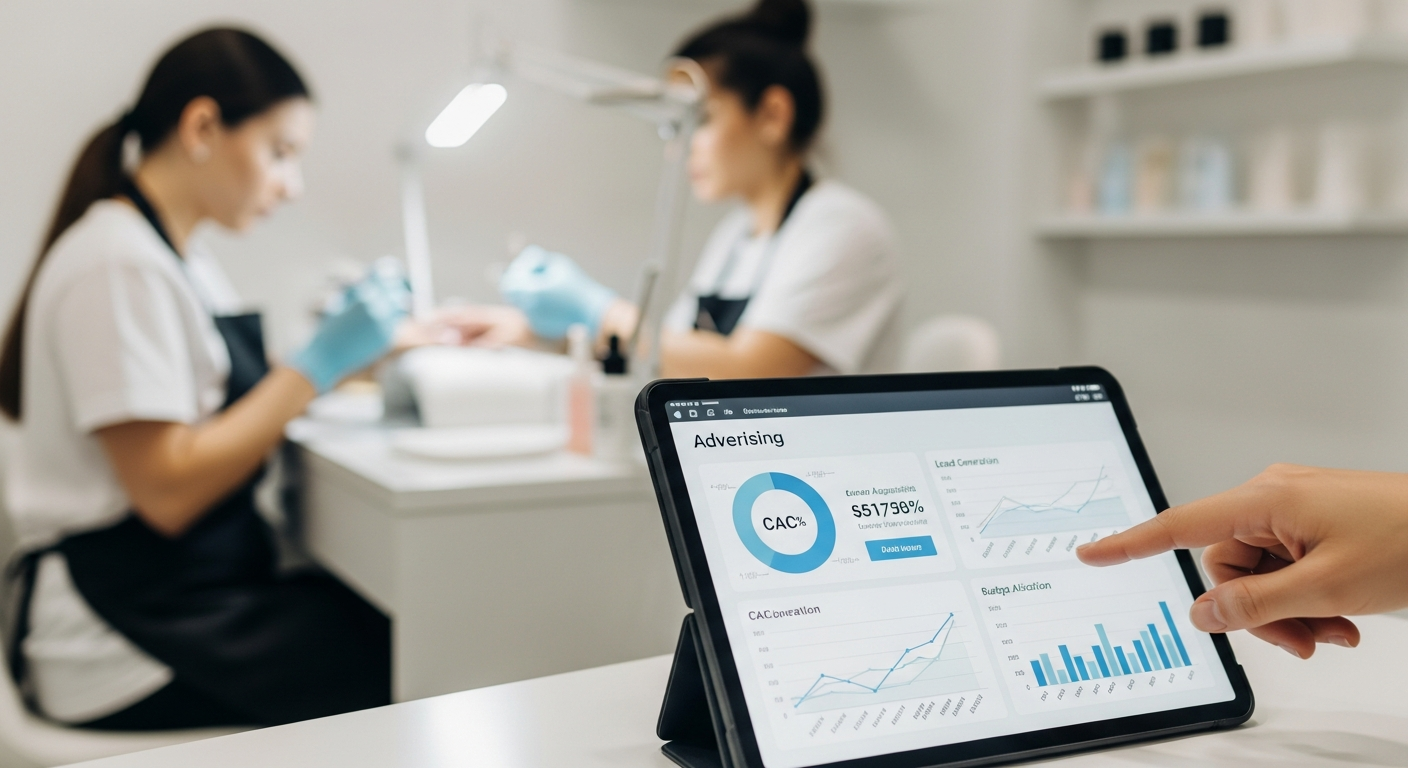
Calculating Customer Acquisition Cost (CAC)
Customer Acquisition Cost, or CAC, is the total amount of money you spend on ads divided by the number of new clients who actually walk through your door and pay for a service.
If you spend $300 on ads in a month and gain 10 new clients, your CAC is $30. You must compare this number to the “Lifetime Value” of a client. A $30 CAC is high if they only visit once for a $20 polish change.
However, if that client returns every two weeks for a year, a $30 investment is highly profitable. Successful advertising focuses on the long-term value of the relationship rather than just the first transaction.
Risks and Realistic Expectations
Paid ads are not a fix for a struggling business. If your salon has poor reviews, a difficult booking process, or inconsistent service quality, advertising will only accelerate those underlying issues.
Ads can get people to click, but they cannot force people to book or return. You should expect a learning phase where some money is spent without immediate bookings as the platform learns who your audience is.
Market saturation also plays a role. In areas with a high density of salons, your cost per lead will naturally be higher. Consistent monitoring of your ad spend versus your actual revenue is the only way to ensure profitability.